


Drinking Fountain ADA Requirements: Everything You Need To Know
 Hydration Insights from the OASIS Team
January 8, 2026
Hydration Insights from the OASIS Team
January 8, 2026
Drinking Fountain ADA Requirements: Everything You Need To Know
Imagine arriving at a busy campus, healthcare facility, or transportation hub and discovering the only drinking fountain is mounted too high for wheelchair users. In an instant, something as simple as taking a sip of water becomes a barrier. ADA compliance prevents that scenario, ensuring every visitor — regardless of mobility — can hydrate with dignity and ease.
The Americans with Disabilities Act (ADA) sets nationwide standards that eliminate physical obstacles and promote equal access to public and commercial spaces. For facility managers, the act isn’t just a legal framework; it’s a roadmap to creating environments where inclusivity and operational efficiency coexist.
Complying with drinking fountain ADA requirements is particularly critical. You’re responsible for selecting, installing, and maintaining fixtures that meet precise height, clearance and operability metrics. Falling short can trigger costly redesigns, fines or even legal action. School administrators, contractors and service teams share the same stakes, especially as diverse user groups — students, patients, travelers and staff — move through your site every day.
OASIS has spent decades engineering hydration solutions that remove guesswork from ADA compliance. From dual-height models to touchless bottle fillers, each product is designed to help you meet the letter of the law while delivering a seamless user experience.
What ADA Is and Why It Matters
The Americans with Disabilities Act is a civil rights law enacted in 1990 to guarantee that people with disabilities enjoy the same access to public life as everyone else. It mandates the removal of barriers that prevent equal participation, covering everything from building entrances and vehicle parking to drinking fountain ADA requirements.
Non-compliance carries both legal and ethical weight. A single complaint can lead to investigations, hefty fines or mandated retrofits that disrupt daily operations. Beyond regulatory risk, ignoring accessibility tarnishes your brand reputation and signals to visitor groups that inclusivity is optional.
Because the ADA applies at every stage — design, construction and ongoing facility upgrades — you must consider its impact the moment you evaluate a site or plan a renovation. Entry points need proper signage, corridors demand precise clearances and fixtures such as fountains must work for wheelchair users without manual change orders after installation. Integrating these standards early saves time, budget and stress down the line.
Two-Unit Requirement: High/Low Installation
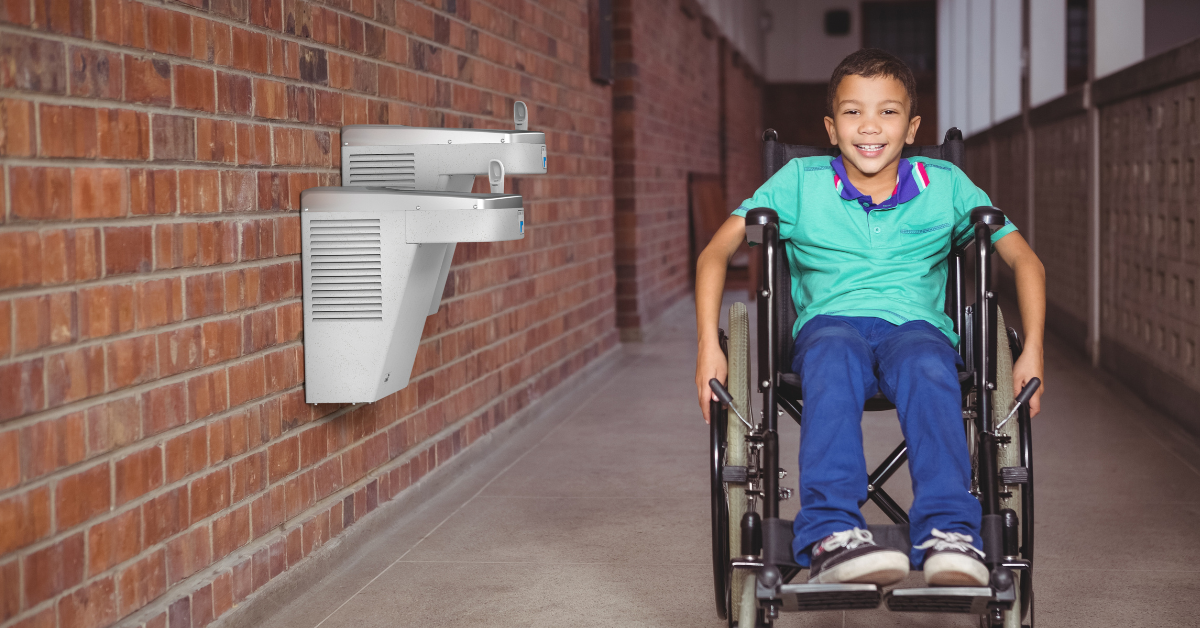
ADA guidelines require providing access for both wheelchair and standing users via separate units. This “high/low” configuration ensures accessibility for both tall individuals and those with mobility challenges. The lower fountain provides a comfortable drinking height for people in wheelchairs, while the higher one is convenient for standing users
OASIS simplifies compliance with dual-height combo units that house both spout levels in a single footprint. Models like the PG8FEBFSL series pair a standard-height cooler with a lower unit and an integrated bottle filler, reducing wall space requirements by half compared to separate fountains. Factory-aligned clearances and ADA plaques mean you can install, test and move on without second-guessing specs.
ADA Requirements for Drinking Fountains
Meeting drinking fountain ADA requirements hinges on precise dimensions and unobstructed access. You need to create a zone where a wheelchair user can roll up, reach the controls and take a drink without strain. Here are the essential elements you must verify before signing off on any installation:
Clear Floor Space
A rectangular area measuring at least 30 inches by 48 inches must be positioned for a centered forward approach on the unit. This space lets a wheelchair maneuver into position without backing into traffic or blocking an entry. If the fountain sits along a main corridor, place tactile signs to guide users and keep the route free of carts, maintenance equipment and vehicle-style cleaning machines that can creep into the approach zone.
Maneuvering and Approach
Front approaches are preferred when you can recess the fountain into a wall alcove, but side approaches often make more sense in narrow sites. Either way, ensure the turning radius — typically 60 inches — stays clear of trash bins, door swings or temporary displays. If change orders alter a corridor’s width mid-project, revisit the layout to protect compliance.
Knee and Toe Clearance
ADA and ANSI A117.1 standards require ≥ 27" high at front (min 8" depth), tapering to 25" at 11" depth, with appropriate toe clearance measuring ≥ 9" high, extending ≥ 17" under the unit. Skirting panels, plumbing covers and half-height enclosures all count toward these measurements, so confirm the final product dimensions match the manufacturer’s information sheet before installation.
Spout Height and Location
The water outlet must be no higher than 36 inches above the finished floor, measured to the spout’s mouth. Position the spout 5 inches from the front edge so users don’t overreach or pour water onto the floor. Angle the stream upward and outward to provide clearance above the front lip, preventing cup contact and supporting bottle use.
The ADA requirements for bubbler heights include:
-
Two heights for children 12 & under: 30” AFF and 36” AFF for a child standing. Generally, the bubbler height is 3” less than the adult height.
-
Adults:
-
Wheelchair: ≤ 36" AFF (spout outlet)
-
Standing: 38" - 43" AFF
-
Operable Parts
Controls need to function with one hand and require less than 5 pounds of force. This means no tight grasping, pinching or twisting. Select touchless sensors or paddle bars that respond to a gentle push.
Watch for protruding objects: Fountains mounted along circulation routes can extend only 4 inches from the wall when set between 27 and 80 inches above the floor. Anything deeper becomes a hazard for people with low vision. Recessed OASIS models keep projections within limits while maintaining internal cold-water tanks.
ADA Guidelines for Special Use Cases
Facility layouts vary, and so do the users who rely on your hydration stations. Adapting the core rules to special situations keeps every visitor safe and comfortable:
Wheelchair Accessibility
ADA reach ranges shift depending on whether a user approaches from the front or the side.
-
Front approach: Operable parts must sit between 15 and 48 inches above the finished floor.
-
Side approach: Operable parts must sit between 15 and 46 inches because the chair’s footrest shortens forward reach.
Keep a clear path at least 36 inches wide from the main entry to the fountain. This corridor must remain free of parked carts or other vehicle-sized maintenance equipment. Placing wall-mounted signs at eye level provides additional guidance for low-vision visitors and simplifies wayfinding for large groups.
Bottle Filling Stations
Integrated bottle fillers streamline operations and encourage sustainable habits, but they add height and depth that can threaten compliance. OASIS combo units resolve this by placing the filler above the standing-height cooler while keeping controls within the 48-inch limit. The result is a half-footprint solution that delivers touch-free hydration, reduces single-use plastics and meets every specification in one package. On a split-level station, the plumbing code recommends that the bottle filler be placed on the unit at the lower height. This way, the wheelchair user can access the bottle filler without the obstructed reach of the nose assembly.
Children’s Specifications
K-12 campuses need lower operable parts, with two spout heights for children 12 and under: 30” AFF and 36” AFF. The clear floor space remains the same, so avoid mounting a filler directly over the child-height fountain; doing so could block the required knee clearance. Instead, use side-by-side or vertically staggered installations that maintain open space beneath the lower basin. Note: Children’s provisions are exceptions, not baseline ADA requirements.
State-Specific Codes
While federal ADA rules form the baseline, local building authorities can tighten requirements.
-
California often mandates lower spout heights — sometimes 34 inches — for adult units and may specify additional tactile signage.
-
Texas emphasizes side-approach clearance at school sites and frequently requires visual contrast strips around protruding objects.
Confirm the latest code cycle with your permitting office before placing an order or authorizing a layout change. Reviewing these details early saves costly rework later and keeps projects on schedule.
Common Compliance Mistakes + How To Avoid Them
Even seasoned facilities teams can overlook details that derail drinking fountain ADA requirements. Recognizing these pitfalls early helps you safeguard budgets, timelines and user satisfaction.
Incorrect Spout Height or Placement
A spout installed even an inch above the 36-inch maximum can force a wheelchair user to lean dangerously or seek help. Verify final measurements on-site before you sign the work order, and double-check that the stream projects within 5 inches of the front edge. Temporary protective covers or misplaced wall signs can also shift alignment during construction, so perform a last-minute inspection right before opening the area to the public.
Inadequate Clear Floor Space and Mounting Errors for Children
Painters’ drop cloths, custodial carts and other vehicle-sized tools often creep into the 30-by-48-inch approach zone once crews move on. Mark the perimeter with floor tape or tactile indicators to keep the entry clear long term. In schools, installers sometimes mount fountains at adult height, assuming children will grow into them. Follow children’s standards from day one; retrofitting later can cost twice as much and disrupt lesson schedules for large student groups.
Failing to Provide High/Low Options and Overlooking Bottle Filler Obstructions
Ordering a single fountain may seem efficient, but the ADA expects a high and a low unit when multiple fixtures are required on the same floor. If space is tight, choose a dual-height model so you cover both user groups in half the footprint. Also, check that a bottle filler’s housing or activation sensor doesn’t extend below the required knee clearance, especially where the filler sits above the lower basin.
Consequences of Non-Compliance
Skipping these details can carry steep penalties:
-
Civil fines up to $150,000 for repeat violations under Department of Justice regulations.
-
Lawsuits from advocacy organizations seeking immediate remediation and attorney fees.
-
Costly retrofits that involve demolition, change orders and new plumbing lines.
Beyond financial impacts, accessibility complaints damage community trust and trigger negative media coverage. Addressing issues proactively keeps your facility’s information desks free of grievances and positions your site as a leader in inclusive design.
Ensure Compliance With OASIS
Choosing the right equipment removes uncertainty from drinking fountain ADA requirements and keeps every site audit-ready. OASIS Coolers offers a portfolio engineered to simplify your to-do list:
-
PG8FEBF and PG8FEBFSL: These dual-height combos pair a chilled water cooler with a hands-free bottle filler, covering high/low installation in one sleek footprint. Integrated sensors activate water flow without tight grasping, protecting users who have limited dexterity.
-
PG8AC and PG8ACSL: Ideal when you need a classic fountain, these models deliver chilled water at the correct 36-inch spout height, provide ample knee clearance and project no more than 4 inches from the wall — eliminating protrusion hazards for groups navigating tight corridors.
All units feature antimicrobial components, corrosion-resistant stainless steel and optional touchless activation for a hygienic, future-proof solution. Every spec sheet details clear floor space, wheelchair approach, mounting heights and required signs so you can verify compliance before issuing a purchase order.
Beyond hardware, OASIS supports facility teams with pre-installation consultation, layout reviews and long-term service plans. If field conditions change unexpectedly — say a last-minute wall depth adjustment or vehicle traffic rerouting — you’ll have expert guidance to adapt without compromising ADA standards.
Ready to guarantee your next entry or renovation meets every rule on the first try? Contact OASIS for product recommendations, specs and expert support and explore OASIS Coolers' ADA-compliant hydration solutions.
About the Author
Explore more articles
Understanding the Surge in Demand for High-Quality Water Solutions
VersaCooler II Drinking Fountains Features and Benefits

VersaFiller Bottle Filler Features and Benefits
Bottle Filling Stations – Trends and Demand